
Featured Member Video
Uses of the Mylar Survival BlanketMore Videos by IA Woodsman
View larger or ask the author a question.
View all wilderness survival videos
Recent Forum Posts 
Come Join the Discussion Today!
Our site has been mentioned in:
U.S. News and World Report
Best of the Web - Site of the Week 8/6/01
Discovery Channel Canada
One Week in the Wilderness
USA Today
Hot Sites 08/08/2005
HOW TO LIGHT A FIRE
Always light your fire from the upwind side. Make sure to lay your tinder, kindling, and fuel so that your fire will burn as long as you need it. Igniters provide the initial heat required to start the tinder burning. They fall into two categories: modern methods and primitive methods.
Modern Methods
Modem igniters use modem devices--items we normally think of to start a fire.
Matches
Make sure these matches are waterproof. Also, store them in a waterproof container along with a dependable striker pad.
Convex Lens
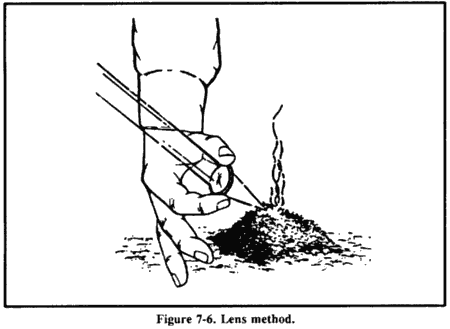
Use this method (Figure 7-6) only on bright, sunny days. The lens can come from binoculars, camera, telescopic sights, or magnifying glasses. Angle the lens to concentrate the sun's rays on the tinder. Hold the lens over the same spot until the tinder begins to smolder. Gently blow or fan the tinder into flame, and apply it to the fire lay.
Metal Match
Place a flat, dry leaf under your tinder with a portion exposed. Place the tip of the metal match on the dry leaf, holding the metal match in one hand and a knife in the other. Scrape your knife against the metal match to produce sparks. The sparks will hit the tinder. When the tinder starts to smolder, proceed as above.
Battery
Use a battery to generate a spark. Use of this method depends on the type of battery available. Attach a wire to each terminal. Touch the ends of the bare wires together next to the tinder so the sparks will ignite it.
Gunpowder
Often, you will have ammunition with your equipment. If so, carefully extract the bullet from the shell casing, and use the gunpowder as tinder. A spark will ignite the powder. Be extremely careful when extracting the bullet from the case.
Primitive Methods
Primitive igniters are those attributed to our early ancestors.
Flint and Steel
The direct spark method is the easiest of the primitive methods to use. The flint and steel method is the most reliable of the direct spark methods. Strike a flint or other hard, sharp-edged rock edge with a piece of carbon steel (stainless steel will not produce a good spark). This method requires a loose-jointed wrist and practice. When a spark has caught in the tinder, blow on it. The spark will spread and burst into flames.
Fire-Plow
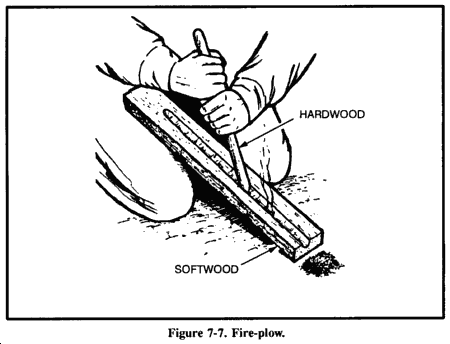
The fire-plow (Figure 7-7) is a friction method of ignition. You rub a hardwood shaft against a softer wood base. To use this method, cut a straight groove in the base and plow the blunt tip of the shaft up and down the groove. The plowing action of the shaft pushes out small particles of wood fibers. Then, as you apply more pressure on each stroke, the friction ignites the wood particles.
Bow and Drill
The technique of starting a fire with a bow and drill (Figure 7-8) is simple, but you must exert much effort and be persistent to produce a fire. You need the following items to use this method:
- Socket. The socket is an easily grasped stone or piece of hardwood or bone with a slight depression in one side. Use it to hold the drill in place and to apply downward pressure.
- Drill. The drill should be a straight, seasoned hardwood stick about 2 centimeters in diameter and 25 centimeters long. The top end is round and the low end blunt (to produce more friction).
- Fire board. Its size is up to you. A seasoned softwood board about 2.5 centimeters thick and 10 centimeters wide is preferable. Cut a depression about 2 centimeters from the edge on one side of the board. On the underside, make a V-shaped cut from the edge of the board to the depression.
- Bow. The bow is a resilient, green stick about 2.5 centimeters in diameter and a string. The type of wood is not important. The bowstring can be any type of cordage. You tie the bowstring from one end of the bow to the other, without any slack.
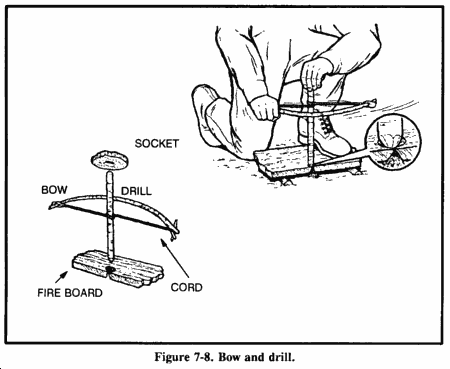
To use the bow and drill, first prepare the fire lay. Then place a bundle of tinder under the V-shaped cut in the fire board. Place one foot on the fire board. Loop the bowstring over the drill and place the drill in the precut depression on the fire board. Place the socket, held in one hand, on the top of the drill to hold it in position. Press down on the drill and saw the bow back and forth to twirl the drill (Figure 7-8). Once you have established a smooth motion, apply more downward pressure and work the bow faster. This action will grind hot black powder into the tinder, causing a spark to catch. Blow on the tinder until it ignites.
Note: Primitive fire-building methods are exhaustive and require practice to ensure success.
|
HELPFUL HINTS |
Use nonaromatic seasoned hardwood for fuel, if possible.
Collect kindling and tinder along the trail.
Add insect repellent to the tinder.
Keep the firewood dry.
Dry damp firewood near the fire.
Bank the fire to keep the coals alive overnight.
Carry lighted punk, when possible.
Be sure the fire is out before leaving camp.
Do not select wood lying on the ground. It may appear to be dry but generally doesn't provide enough friction.
Ultimate Survival Knife & Kit |
List Price: 61.99 Our Price: 39.95 |
This 15 inch survival knife with drop point blade features a thick quality stainless steel blade with serrated top edge. Textured and ribbed solid metal handle and guard. Nylon sheath. Survival kit includes a hollow grip with a compass top to store items within the knife itself, as well as additional pouches on the sheath to hold the rest. Complete survival kit. Click Here to Buy the Survival Knife Now. |
|
